


Disclosure: This article contains affiliate links. We may earn a commission from purchases at no extra cost to you, which helps our travel content.
When I first arrived in Asheville last October, the mountains were ablaze with autumn colors that reminded me of the nebular clouds I've spent decades studying—vibrant, dynamic, and constantly shifting in the light. As an astronomer accustomed to remote observation sites, I found myself drawn to this small city nestled in the Blue Ridge Mountains not for its night skies (though they are remarkable), but for its gravitational pull as a creative vortex. Like distant galaxies that appear small but contain immense energy, Asheville's modest footprint belies its outsized artistic influence. My weekend exploration revealed a place where art isn't merely displayed—it's lived, breathed, and woven into the very fabric of daily life. From studios housed in repurposed industrial buildings to street performances that turn ordinary corners into stages, Asheville offers a perfect celestial alignment of natural beauty and human creativity.

The River Arts District: A Creative Constellation
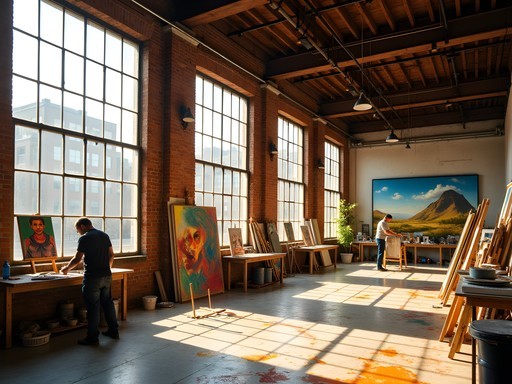
The River Arts District (RAD) stretches along the French Broad River like a stellar nursery where new artistic life constantly emerges. Once dominated by industrial warehouses, this area has undergone a transformation akin to the life cycle of a star—what was once utilitarian has collapsed and reformed into something luminous and essential.
During my visit, I spent an entire day wandering through more than 200 artists' studios spread across 23 historic buildings. What struck me most was the accessibility—unlike the distant celestial bodies I typically study, here the creative process is immediate and tangible. Artists don't just display finished works; they invite you into their process.
At Wedge Studios, I watched a glassblower manipulate molten material that glowed like the surface of a red dwarf star. The precision required reminded me of calibrating telescopes in the Atacama Desert—each movement deliberate, each decision affecting the final outcome. Nearby at Pink Dog Creative, painters worked with palettes that captured the same spectrum analysis I've used to identify elements in distant suns.
For those planning to photograph this vibrant district, I relied on my travel tripod to capture the warm afternoon light filtering through the industrial windows. Its compact size made it easy to carry as I traversed the district, yet it provided the stability needed for interior low-light shots of artists at work.
Between studio visits, the White Duck Taco Shop provided a perfect refueling station. Like observing sessions that require sustenance to maintain focus, artistic exploration demands energy—their creative takes on global taco traditions delivered exactly what was needed.

💡 Pro Tips
- Visit on a Second Saturday when most studios host special events and demonstrations
- Start at the north end near Riverview Station and work your way south
- Download the RAD studio guide app for real-time information about which studios are open
Downtown Asheville: The Urban Observatory
Downtown Asheville functions like an observatory of human creativity—a place where various artistic expressions can be viewed in close proximity. The compact city center, with its Art Deco architecture, offers a walking experience that feels like traversing a carefully curated galaxy of creative expression.
I joined a walking tour led by a local historian who explained how Asheville's preserved architectural heritage stems from an unusual source: the Great Depression. When the city went bankrupt, it couldn't afford urban renewal projects that demolished historic buildings in other American cities. This economic black hole inadvertently preserved architectural treasures that now house galleries, boutiques, and performance spaces.
At the heart of downtown stands the Asheville Art Museum, recently expanded and renovated. Its collection focuses on American art of the 20th and 21st centuries, with special emphasis on artists from the Southeast. As someone who studies the most distant objects in our universe, I found myself drawn to the museum's collection of Black Mountain College works—a legendary experimental arts school that operated nearby from 1933 to 1957. The college's interdisciplinary approach reminds me of modern astrophysics, where boundaries between specialties blur in pursuit of deeper understanding.
For capturing the architectural details of downtown's buildings, I relied on my wide-angle lens. The lens allowed me to photograph entire façades even in narrow streets, preserving the intricate details that make Asheville's built environment so distinctive.
In the evening, I discovered that downtown Asheville hosts a drum circle every Friday in Pritchard Park—a rhythmic phenomenon as predictable and mesmerizing as celestial rotations. Participants and observers form concentric rings, creating a living model of a planetary system united by the gravitational pull of rhythm.

💡 Pro Tips
- Take the Urban Trail self-guided tour marked by bronze sculptures throughout downtown
- Visit Pack Square Park where street performers often gather, especially on weekend afternoons
- Check the schedule for free gallery walks held on first Fridays of each month
Folk Arts and Mountain Heritage
Just as different cultures throughout human history have developed their own interpretations of the night sky, the Appalachian region surrounding Asheville has cultivated distinctive artistic traditions that tell the story of its people. These folk arts function like constellation myths—they organize experience into meaningful patterns passed down through generations.
The Folk Art Center, located on the Blue Ridge Parkway just east of Asheville, serves as the headquarters for the Southern Highland Craft Guild. During my visit, I spent hours examining the exquisite craftsmanship of woodworkers, weavers, potters, and instrument makers. What fascinated me was how these artisans use techniques developed over centuries, much like how astronomers build upon observations made by our predecessors.
I had the good fortune to visit during a demonstration by a traditional ballad singer whose songs mapped the emotional terrain of mountain life with the same precision that star charts map the heavens. These unaccompanied vocals, carried across generations, preserve stories and wisdom in their melodic patterns.
Further afield, I drove to the small town of Marshall (about 25 minutes from Asheville) to visit the Madison County Arts Council, where I found pottery incorporating regional clay—a literal incorporation of the land into artistic expression. The potter explained that the iron content in local clay produces distinctive red hues when fired, connecting each piece to the specific geology of the region.
To truly understand Appalachian culture, I attended a jam session at the Shindig on the Green (held Saturday evenings during summer at Pack Square Park). Musicians of all ages gathered in small clusters, playing traditional tunes on fiddles, banjos, and dulcimers. The music spreads organically, like ripples in the cosmic background radiation, with tunes passing from group to group in a beautiful demonstration of cultural continuity.
For documenting these rich traditions, my digital voice recorder proved invaluable for capturing the authentic sounds of Appalachian music. The ability to record high-quality audio allowed me to preserve the nuances of these musical traditions—a different kind of data collection than my usual astronomical observations, but equally meaningful for understanding human expression.

💡 Pro Tips
- Check the Folk Art Center schedule for craft demonstrations held most days
- Visit during the annual Heritage Weekend in September for the most comprehensive experience of traditional crafts
- Look for community jam sessions posted at local music stores for authentic mountain music experiences

Asheville After Dark: Stars Above, Art Below
As an astronomer, I've developed a professional appreciation for darkness. Asheville offers a fascinating juxtaposition: as natural darkness falls, the city's cultural light shines even brighter. The nighttime arts scene here pulses with energy that rivals the brilliance of the stars visible from the surrounding mountains.
My evening explorations began at the Asheville Masonic Temple, where I attended a performance by the Asheville Symphony Orchestra. The Temple's Egyptian Revival architecture created an appropriate setting for music that, like astronomy, attempts to express the ineffable through mathematical precision. The program featured a piece inspired by celestial movements—a reminder that artists and scientists often draw inspiration from the same cosmic sources.
Later, I ventured to the South Slope district, formerly industrial buildings now transformed into breweries that double as performance venues. At the Orange Peel, listed by Rolling Stone as one of the top rock clubs in America, I witnessed a musical performance that demonstrated how Asheville attracts talent from across the musical spectrum. The venue's excellent acoustics reminded me of the radio telescopes I've worked with—both designed to capture waves that carry meaningful information across distances.
For those interested in combining stargazing with cultural experiences, I recommend heading to the Asheville Museum of Science, which occasionally hosts evening events where visitors can enjoy both astronomical observations and exhibits about the region's natural history. During my visit, they featured a special program on how Cherokee traditions interpret celestial phenomena—a beautiful example of how different knowledge systems can illuminate the same observable universe.
After these cultural experiences, I drove just 20 minutes outside the city limits to find dark skies suitable for serious stargazing. With my compact binoculars, I was able to observe star clusters and nebulae above the silhouetted mountain ridges. These binoculars offer an excellent balance of portability and light-gathering capability—perfect for the traveler who wants to explore both cultural and celestial landscapes.
What makes Asheville unique is this proximity—one can move between sophisticated artistic experiences and natural darkness within minutes, experiencing both human creativity and cosmic wonders in a single evening.

💡 Pro Tips
- Check the Asheville Symphony Orchestra schedule for special performances in unique venues
- Visit rooftop bars like Capella on 9 or The Montford for cityscape views combined with craft cocktails
- Download a star chart app to identify constellations visible from nearby Blue Ridge Parkway overlooks
Seasonal Festivals: Asheville's Cultural Orbit
Just as celestial bodies follow predictable orbits, Asheville's cultural calendar revolves around seasonal festivals that mark the passage of time with artistic celebration. My autumn visit coincided with several of these events, each offering a different facet of the city's creative identity.
The LEAF Downtown festival transforms Pack Square Park into a multicultural celebration featuring music, dance, and art from around the world. What struck me was how this festival, like my astronomical research, emphasizes connections across vast distances—in this case, cultural rather than spatial. Watching performers from five continents share a single stage reminded me that art, like science, transcends borders.
During my weekend visit, I was fortunate to experience the River Arts District Studio Stroll, held twice yearly in spring and fall. Unlike my daily exploration of individual studios, this festival atmosphere brought all the district's creative energy to peak intensity. Artists who normally work behind closed doors opened their spaces, demonstrated techniques, and engaged directly with visitors. The collective energy reminded me of stellar formation regions where increased density leads to new creative births.
One particularly memorable experience was the Asheville Percussion Festival, which explores rhythm traditions from around the world. As someone who studies the rhythmic patterns of celestial bodies—from pulsar rotations to planetary orbits—I found fascinating parallels in how human cultures express time through beat and pattern.
For photographers visiting during festivals, I found my camera rain cover essential for Asheville's unpredictable mountain weather. Fall brings occasional showers that can appear suddenly, and this simple protection allowed me to continue documenting festival activities regardless of conditions.
What makes Asheville's festivals special is their accessibility and authentic connection to place. Unlike commercialized events in larger cities, these celebrations maintain intimate scale and genuine ties to local creative communities. They function as cultural observatories where visitors can witness the ongoing evolution of artistic traditions in real time.

💡 Pro Tips
- Check the Explore Asheville website for a comprehensive festival calendar before planning your trip
- Book accommodations well in advance for major festivals like LEAF or the Craft Fair of the Southern Highlands
- Look for festival satellite events in smaller venues that often feature more experimental work
Final Thoughts
As I departed Asheville, driving along the Blue Ridge Parkway with the city receding in my rearview mirror, I found myself contemplating the parallels between my two passions: studying the cosmos and exploring human creativity. Both require us to look closely at patterns, to find meaning in the interplay of light and darkness, and to recognize how seemingly disparate elements form a coherent whole. Asheville exemplifies this integration—a place where natural beauty and human expression exist not in competition but in conversation. Whether you're drawn to traditional crafts that connect us to our past, contemporary art that challenges our perspectives, or the simple pleasure of music shared among friends, this mountain city offers a creative universe worth exploring. Like the best astronomical observations, a visit to Asheville rewards both careful analysis and open-hearted wonder. I'll return again, perhaps in spring when different constellations grace the night sky, to discover new dimensions of this remarkably creative community.
✨ Key Takeaways
- Asheville's artistic identity spans traditional Appalachian crafts to cutting-edge contemporary work
- The compact city center allows visitors to experience diverse creative expressions within walking distance
- Fall offers ideal conditions with mild weather, vibrant foliage, and numerous cultural festivals
- The proximity of natural areas to cultural venues creates unique opportunities for combining outdoor and artistic experiences
📋 Practical Information
Best Time to Visit
Fall (September-November)
Budget Estimate
$150-250 per day including accommodations, meals, and activities
Recommended Duration
3-4 days minimum, weekend viable for highlights
Difficulty Level
Beginner

Comments
wanderbackpacker2639
Great post! Just want to add that October is peak season so it gets crazy crowded. I actually prefer visiting in late winter/early spring when it's quieter and you can actually talk to the artists in their studios without the crowds. The mountains are beautiful year-round honestly
Sophia Gomez
Claire, I love how you connected your astronomy background to the art scene - such a unique perspective! I was in Asheville for a conference last fall and completely fell in love with the Folk Art Center. The traditional quilts there tell such incredible stories about Appalachian heritage. Did you get a chance to catch any live music while you were there? The bluegrass scene downtown is absolutely electric on weekend nights. I ended up at this tiny venue on Lexington Avenue and it was one of those magical travel moments you can't plan for.
freezone
Which venue was it? I'm going in March!
wanderlegend
How much time would you recommend for the River Arts District? Planning a trip in spring and trying to figure out my itinerary. Also is parking easy to find there?
wanderbackpacker2639
Not the author but I spent a whole afternoon there last year! Parking was pretty easy, lots of free spots near the studios. Definitely give yourself at least 3-4 hours to really explore
wanderlegend
Perfect, thanks! That's super helpful
freezone
This is awesome! Adding Asheville to my list right now
Savannah Walker
Claire, your section on Asheville After Dark brought back such memories! Last winter I found myself at The Grey Eagle for a bluegrass show that turned into one of those magical travel moments. The crowd was this perfect mix of locals and visitors, all stomping and clapping along. Afterward, we followed some locals to a tiny jazz bar tucked away downtown that I never would have found otherwise. The bartender was mixing cocktails with local mountain herbs I'd never heard of. This is what makes Asheville special - that blend of traditional Appalachian culture with this progressive artistic energy. For anyone visiting, don't just stick to the main streets. The real Asheville magic happens when you venture down those side alleys and follow the sound of banjos or saxophones coming from unexpected places.
wanderlegend
What was the name of that jazz bar? Going next month and love finding hidden spots!
Savannah Walker
It was Crow & Quill! Very speakeasy vibe, amazing cocktails. Check their schedule online first.
mountainone
Local here - glad you captured our city's creative spirit so well! Come back for summer when all the outdoor concerts are happening.
wanderstar
Just got back from Asheville and your blog post was spot on! We spent a whole day in the River Arts District and watched a glassblowing demonstration that blew our minds. The Folk Art Center on the Blue Ridge Parkway was also amazing - picked up a handmade mug that I'll treasure forever. Didn't make it to as many music venues as I wanted though.
roamexplorer
Which glassblowing studio did you visit? Planning to go in January.
wanderstar
It was North Carolina Glass Center! They do daily demos and you can even sign up for a mini-workshop to make your own ornament.
Bryce Diaz
Claire, your comparison of Asheville's autumn palette to nebular clouds is spot on! I spent two weeks there last fall doing a solo photography project. The River Arts District has this incredible industrial-meets-creative energy that I haven't found anywhere else. I spent hours talking with glass blowers and ceramic artists about their craft. One tip for visitors: many studios have different open hours, so check the RAD website before going. I used my travel tripod for some night shots along the French Broad River that turned out magical. The way the city lights reflect on the water while the mountains loom dark in the background is a photographer's dream.
freepro
Is public transportation good enough to get around or should I rent a car?
mountainone
Definitely rent a car if you want to see the parkway and surrounding areas. Downtown is walkable though.
wanderstar
Which galleries in the River Arts District would you recommend for someone with limited time? Only have about 3 hours to explore when I visit next month.
Savannah Walker
Not Claire, but I was there in December! Don't miss Wedge Studios and Pink Dog Creative. Both have multiple artists under one roof so you can see a lot in a short time. Also grab coffee at Ultra Coffee Bar while you're there - amazing view of the river!
wanderstar
Thanks so much! Adding those to my list right now.
Venture X
Premium card with 2X miles, $300 travel credit, Priority Pass